
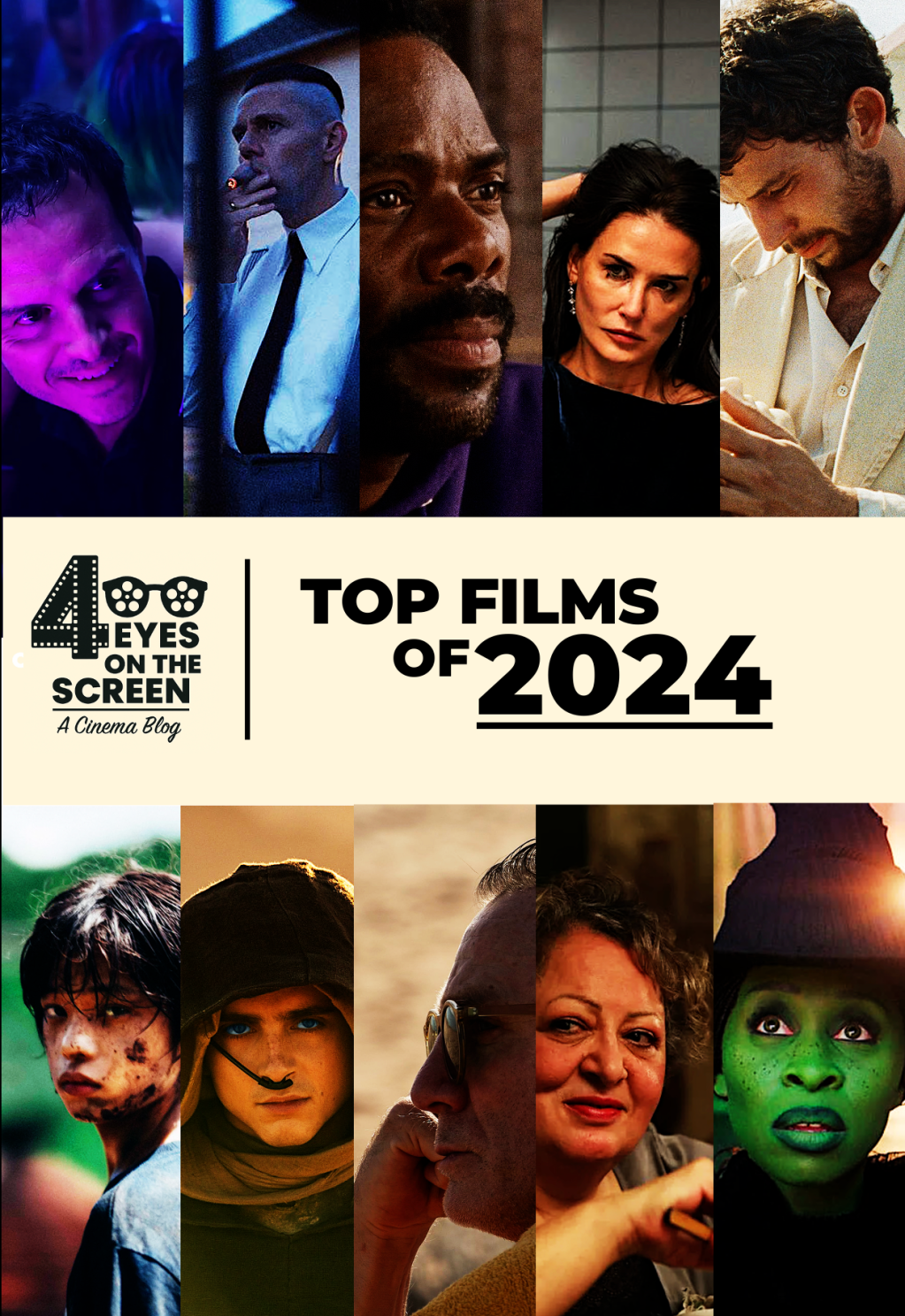
So, 2024 was the year I kept my promise. Rather than drop a huge post of all my film reviews in one go (no doubt leading to exhaustion on the part of the reader and writer – the second I know for definite), I’ve managed to create three posts on my top films of the year!
My first review from May can be read here.
My second review from October can be read here.
Unfortunately, life changes have meant that the podcast ‘Even More Eyes’ has been on hiatus since May (the last episode being on one of my top films for this year- Dune: Part Two– so check that out). My co-host Imo and I have plans to return with more retrospectives and reviews in 2025, albeit at a less frequent rate than our 2021-2023 run. Please watch this space.
2024 has been a phenomenal year for film and whether by selective curating or just missing out on some stinkers, I can’t say that I can give a single star to any one film that I had the pleasure of viewing this year. In fact, so many good pieces of cinema have been on the screen in the last twelve months that I struggled to narrow it down (though I have managed somehow).
MY TOP 10 FILMS OF 2024 (in no particular order):
- ALL OF US STRANGERS
- THE ZONE OF INTEREST
- SING SING
- THE SUBSTANCE
- LA CHIMERA
- 怪物 (MONSTER)
- DUNE: PART TWO
- QUEER
- کیک محبوب من (MY FAVOURITE CAKE)
- WICKED
In many of the top films I’ve selected for this year, I feel certain thematic threads that I’d like to pull out for a moment. The reinvention of self seems to be the most prominent, especially when confronting the past. Andrew Haigh’s All of Us Strangers (which I think has been the most personally affecting for me this year) seemed to start this thought ball rolling, as Andrew Scott’s protagonist grapples with how to grieve his past as much as how to be gay in his near-middle age. Sing Sing, Queer, La chimera, My Favourite Cake, Monster and, yes, even Dune: Part Two and Wicked (though on a much more epic level) seem to grapple with this same struggle of selfhood and the past, alongside being formed by forces both internal and external. Sometimes, in the case of Dune’s Paul Atreides and Wicked’s Elphaba Thropp, this self-journey serves to destroy a corrupt status quo. They survive and succeed, unlike the tragic burgeoning younger characters in Hirokazu Kore-eda’s hard-hitting Monster. For others, like Daniel Craig’s William Lee (Queer), Lily Farhadpour’s Mahin (My Favourite Cake) and Demi Moore’s Elizabeth Sparkle (The Substance) their self-struggle is to accept a life lived and lost, replaced with new aggrieving circumstances that they often cannot escape. Will such characters recognise the need for healthy self-reinvention? La chimera’s Arthur, played by Josh O’Connor, shows the opportunity to seek renewal despite the temptation of the past, much like Colman Domingo’s indefatigable playwright in Sing Sing.
I’m not too sure about where Jonathan Glazer’s The Zone of Interest falls in these self-indulgent philosophical musings…the selves seen in the most disturbing historical drama of the year must be understood if we are to have a chance at saving our humanity and it’s attendant societies.
Moving on.
In any case, here are my final extended reviews of the top films between October and December.
کیک محبوب من (MY FAVOURITE CAKE): Lily Farhadpour Serves A Powerful Performance In This Bittersweet Slice of Cinema.
Director: Maryam Moghaddam, Behtash Sanaeeha / Screenplay: Maryam Moghaddam, Behtash Sanaeeha
In contemporary Iran, Mahin (Lily Farhadpour), a seventy-year-old widow of three decades, lives a lonely life. Her children live abroad, and her friends only visit once a year to discuss increasing ailments and bitter marriages. When Mahin goes to a pensioner restaurant one day, she spies another lonesome soul in Faramarz (Esmail Mehrabi), a seventy-two-year-old taxi driver. After a brief encounter, they return to Mahin’s home for a night of food, wine, love and loss.
Director-writers Maryam Moghaddam and Behtash Saneeha’s sweet tragicomedy is iced with political critique and allegorical resonance to women’s lives in post-revolutionary Iran (for which the filmmakers have been sanctioned by the current Iranian government). The melancholy for a bygone time of personal freedoms and the intensity of moral censorship in the country are witnessed unflinchingly in Mahin’s daily life.
Perhaps more prominently, My Favourite Cake conveys the difficulties of ageing and the apprehension of giving love a chance again in life’s twilight years. The film’s stark palette of pale naturalistic lighting starts to warm and the static camerawork becomes a whirling dervish when Mahin and Faramarz are drawn together. Farhadpour and Mehrabi are a wonderful screen couple, serving their characters justice with genuine weariness, warmth, wit and despair.
Unfortunately, the film only suffers from the extreme romantic promises in its dialogue, and a creeping scepticism of the characters’ fates creates a nagging foreboding. Nevertheless, Farhadpour delivers on the film’s truly heartbreaking final scenes, which underscore My Favourite Cake’s salient message: enjoy life’s treats before they are gone.
Where to Watch: My Favourite Cake is available to watch now on Curzon Home Cinema, Amazon Prime Video and BFI Player.
My Verdict // ★★★★☆
WICKED: Leading Duo Cynthia Erivo and Ariana Grande Are the Wondefying Witches of the Season.
Director: Jon M. Chu / Screenplay: Winnie Holzman, Dana Fox – based on the 2003 Broadway musical inspired by the 1995 novel of the same name by Gregory Maguire.
It’s all doubles, bubbles, toils and troubles in Jon M. Chu’s film adaptation of the beloved Broadway musical Wicked. The early Noughties’ stage show is renowned for popularising Gregory Maguire’s provocative revisionist novel that turned The Wizard of Oz’s infamous Wicked Witch into a tragic hero.
Born with green skin and rare magical gifts, Elphaba Thropp (Cynthia Erivo) must struggle with the scorn and shame of all those around her – even her father and sister Nessa Rose (Marissa Bode). These struggles only intensify when she arrives at Shiz Academy (a less-lethal, less-magical Ozian Hogwarts). While her unique talents catch the attention of the sorcery professor Madam Morrible (Michelle Yeoh), she is roomed with the self-obsessed Galinda (Ariana Grande), a popular student who lives her own pink-tinted bubble of designer outfits and fawning sycophants (hilariously improvised by Bowen Yang and Bronwyn Jane). As their rivalry soon softens into friendship, Elphaba begins to realise something is deeply wrong in Oz. Intelligent verbal Animals are being systematically silenced and marginalised. She believes only one person can help them: her childhood idol, the Wonderful Wizard of the Emerald City (Jeff Goldblum).
Chu’s long-awaited screen version is a stirring, dazzling rendering of the stage show. The choreography has extra stomp, slightly rescored renditions of the musical numbers are refreshing, and with the film’s one hundred and sixty-minute run-time, the story gets a chance to explain the fantasy’s lore that eluded the theatre version (surprisingly though, none of Maguire’s cut book material makes it into this extended Part One). Reverent to the original’s source, Chu often tips a (pointy) hat to the 1939 classic movie and the show’s long Broadway run (with certain cameos that are neither fleeting nor glancing).
The film’s soaring triumph is the chemistry between Grande’s floaty, giddy Glinda and Erivo’s grounded, demure Elphaba. While Grande can have scene-stealing hyperactive energy and comedic timing that makes her rival melt into the background in certain moments, Erivo’s wicked-witch-in-waiting truly entrances with her emotional gravity and wonderful vocal range. She goes from joyous abandon (‘The Wizard and I’) to quiet longing (‘I’m Not That Girl’) and, finally, to a goose-bump-inducing battle cry in the film’s final duet (‘Defying Gravity’). The rest of the ensemble cast is also a delight, even with Goldblum infusing his typical off-screen physical-verbal quirkiness into the dubious wizard.
Such a magical first act will be difficult to follow, so Chu needs to defy expectations with Part Two next year!
Where to Watch: Wicked is available to watch now on Amazon Prime Video.
My Verdict // ★★★★★
THE SUBSTANCE: Fargeat’s ‘The Portrait of Demi Moore’ Is an Outrageous, Delirious Tonic for Hollywood’s Cruelty.
Director: Coralie Fargeat/ Screenplay: Coralie Fargeat.
Cinema has never had a problem making Hollywood look at itself in the mirror…but never like director-writer Coralie Fargeat’s neo-Gothic outrage of a movie The Substance.
When former Hollywood starlet Elizabeth Sparkle (Demi Moore) hits an abrupt end to her career, she seeks desperate help with a mysterious experimental substance. The lurid green goo creates the younger, ‘perfected’ version of herself (Margaret Qualley) that her lewd producer (Dennis Quaid) is hungry for. However, her life spirals out of control when she struggles to maintain the strict balance necessary to keep the trial safe.
Fargeat pulls no punches in this pointedly satirical and delirious takedown of Hollywood’s cruelty towards the female stars it puts up and rips down. Fargeat uses a cine-literate aesthetic to expose the sadness, pain, power and disgust involved in maintaining the myth of beauty to advance a woman’s high-profile career. Unsubtle references to The Shining, Psycho, The Fly, The Elephant Man and The Silence of the Lambs (to name only a few) draw attention to the exploitative, unsatiated male gaze that can often pervade the horror genre. On a more visceral level, the sound design is tweaked up so that every squelch and squeeze makes you shift uncomfortably in your seat, while the David Cronenberg-inspired body horror ramps until it becomes almost unbearable to watch.
But it’s not the wobbly pink tendons, gaping wounds and gallons of blood that are The Substance’s most disturbing elements. The film’s worst ‘body-horror’ moment cuts deep for being all too familiar. After deciding to reconnect with a former adoring classmate, an emotionally crushing moment in the mirror for Sparkle is truly pitiable. While both Qualley and Moore get their moments to indulge before the camera (from palpable panic to sheer lunacy), it is Moore’s terrific lead performance that connects the audience with this sustained portrait of self-loathing.
Where to Watch: The Substance is available to watch now on MUBI and Amazon Prime Video.
My Verdict // ★★★★☆
QUEER: Daniel Craig Dives into Hidden, Painful Depths in Guadagnino’s Trippy Adaptation.
Director: Luca Guadagnino / Screenplay: Justin Kuritzkes – based on the 1985 novella of the same name by William S. Burroughs.
Based in 1950’s Mexico, middle-aged American literary loafer William Lee (Daniel Craig) becomes infatuated with a handsome young G.I called Eugene Allerton (Drew Starkey). However, with Allerton blowing hot and cold to his advances, Lee proposes a trip to South America to find a substance capable of enhancing the potential for human telepathy. It’s an adventure as whimsical as Lee’s drug-fuelled, tequila-soaked sojourns through the bars of Mexico City. But he sees it as his one chance to gain a genuine connection with his elusive, non-committal lover.
Continuing to prove that he can adapt content into cinematic form, director-writer Luca Guadagnino has created a truly ‘queer’ piece of filmmaking that draws carefully from William S. Burrough’s novella. Just as he utilised a tennis-rally like structure for his ménage à trots thriller Challengers (2024) earlier this year, the noticeably artificial backdrops of Mexico with the alternating editing and camerawork (jerky cutting during the starkly lit day scenes to slowed-down sequences at night scored with anachronistic needle-drops) are all evocative of Lee’s tortured, decaying imagination. While the film struggles to maintain our attention at times due to its trippy nature, the trepidation of trying to achieve intimacy despite sexuality and age is palpable. There is a deep pain in Queer‘s depiction of gay lives that, in the past, were trapped in loops of self-denial and self-destruction.
Craig is in top form here as the Burroughs-inspired protagonist. After years of masculine (albeit more self-reflective) posturing as James Bond and bumbling fun as Benoit Blanc (Knives Out, Glass Onion), he delivers a truly vulnerable lead performance. It’s the most difficult, distressing and detailed character work the actor has given in years. Often sweating with tequila and childishly tremulous behind smudged spectacles, Craig captures a man in near-permanent inebriation and emotional longing.
Queer is not Guadagnino’s easiest work and no doubt will take a back seat to his more accessible romance Call Me By Your Name (2017). However, the film’s cinematic exuberance and darker reflections remain long after its hallucinogenic effects wear off.
Where to Watch: Queer is available to watch now on MUBI.
My Verdict // ★★★★☆
And, finally, some short reviews of the last few films I saw this year, many of which are now available on a number of streaming services…
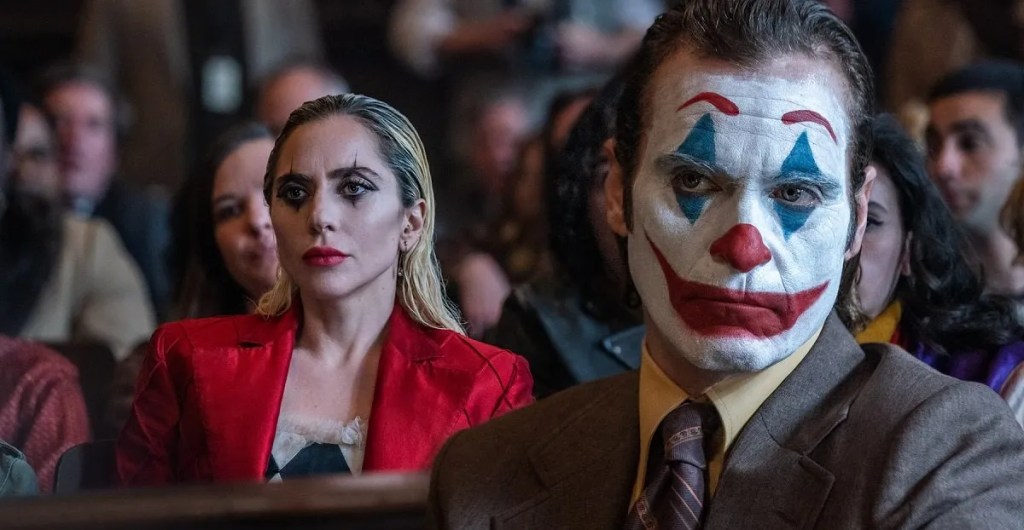
Joker: Folie à Deux (Dir. Todd Phillips, Screenplay. Todd Phillips, Scott Silver): Arthur C. Fleck (Joaquin Phoenix), the poor, mentally deranged, failed comedian, who has become a notorious celebrity known on the street as ‘The Joker’ is facing an appeal trial. His lawyer is convinced an insanity plea will help him escape from the relentless abuse he receives as an inmate at Arkham Asylum. But Arthur’s head has been turned by a fellow inmate – the enigmatic, obsessive Lee Quin (Lady Gaga)- and he’s determined to imagine a wonderful future with her. While Todd Phillip’s musical tragicomic sequel to Joker (2019) is certainly bold in its style, it’s often directionless with its story. The chemistry between the clown-royalty-of-crime works when they are given scenes together, but there’s just not enough of the duo. Gaga’s sad, unpredictable, fixating reimagining of Harley Quinn is wasted. As the film flounders with its dance numbers and dull trial scenes, Joker: Folie à Deux ultimately fizzles out with all the wheeze of a whoopee cushion. My Verdict // ★★☆☆☆

The Wild Robot (Dir. Chris Sanders, Screenplay. Chris Sanders – based on the 2016 book of the same name by Peter Brown): Set in an indeterminate future, benign robots called ROZZUMS, designed by global tech-corporation Universal Dynamics, assist mankind with every task. When ROZZUM 7134 (voiced by Lupita Nyong’o) crashes on a remote island in the middle of the ocean during routine transportation, she becomes driven to help the local wildlife. However, most of the animals consider her a metallic monster best kept at a distance. After an unfortunate accident, ‘Roz’ is given a task she was not prepared for: raising a gosling (voiced by Kit Connor) to fly before a deadly winter strikes the island. Director-writer Chris Sanders adapts Peter Brown’s 2016 novel with sublime animation to create a wonderful, heartfelt story on the trials, tribulations and triumphs of parenthood. While most of the film works subtly as an effective allegory of the difficult path of setbacks and sacrifices that parents often make for their children, only an attention-deficit-pleasing battle at the finale weakens this otherwise beguiling animated tale. My Verdict // ★★★☆☆
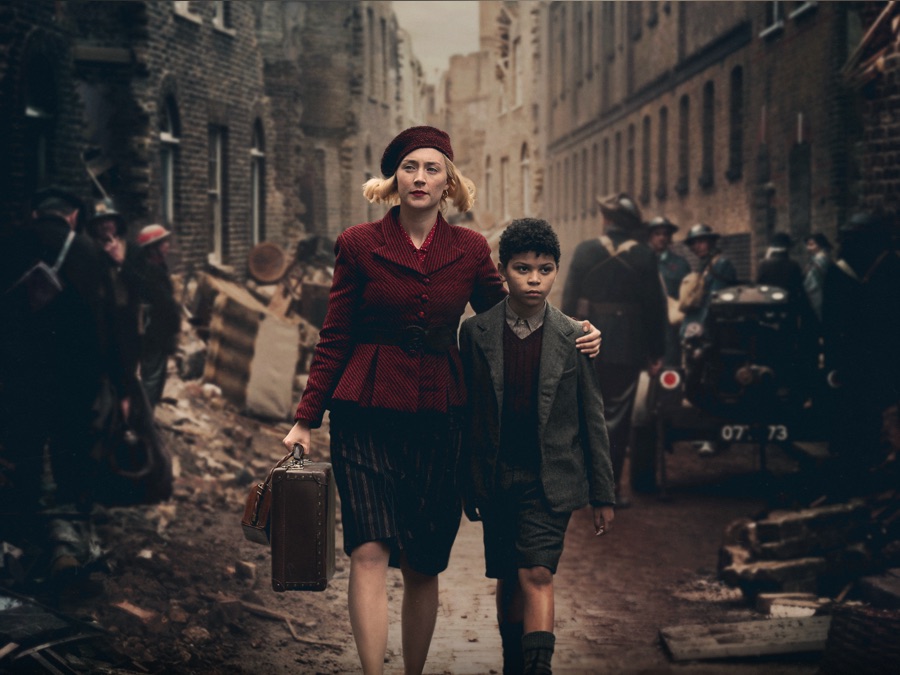
Blitz (Dir. Steve McQueen, Screenplay. Steve McQueen): London. 1940. As the ‘Blitz’ (the air raids carried out by the German air forces on Britain during the Second World War) intensifies, factory worker Rita (Saoirse Ronan) decides to evacuate her mixed-race son George (Elliott Heffernan) to the country. However, when George fears his treatment elsewhere in Britain is going to be worse than London’s due to his race, he jumps from the evacuee’s train. His journey home will take him through the bomb-torn city to discover the terrors of the ‘Blitz’ firsthand. Unambiguously, director-writer Steve McQueen has discarded the nostalgic notions of solidarity that have often mythologised this period of British history. A notably vicious, uncontrollable, serpentine-like fire hose thrashes violently in the film’s fraught opening moments. It establishes that this movie’s experience will be both immediate and terrifying, and Blitz is certainly an original cinematic depiction of the time. It’s style blends horror-disaster and social-realist drama with gritty scenes of collapsing ruins, flooded London Underground shelters, alongside pointed commentary on race and class in wartime Britain. However, as can be expected from this genre mash, the tone becomes uneven and the screenplay’s coincidences, contrivances and characterisations dent any realism to the point it becomes ridiculous (especially Stephen Graham and Kathy Burke as two criminal grotesques who seem like they’ve fallen off the stage of Les Misérables). Nevertheless, Ronan and newcomer Heffernan are convincing as the plucky mother and son which form the film’s heart. They hold Blitz back from bombing completely. My Verdict // ★★★☆☆
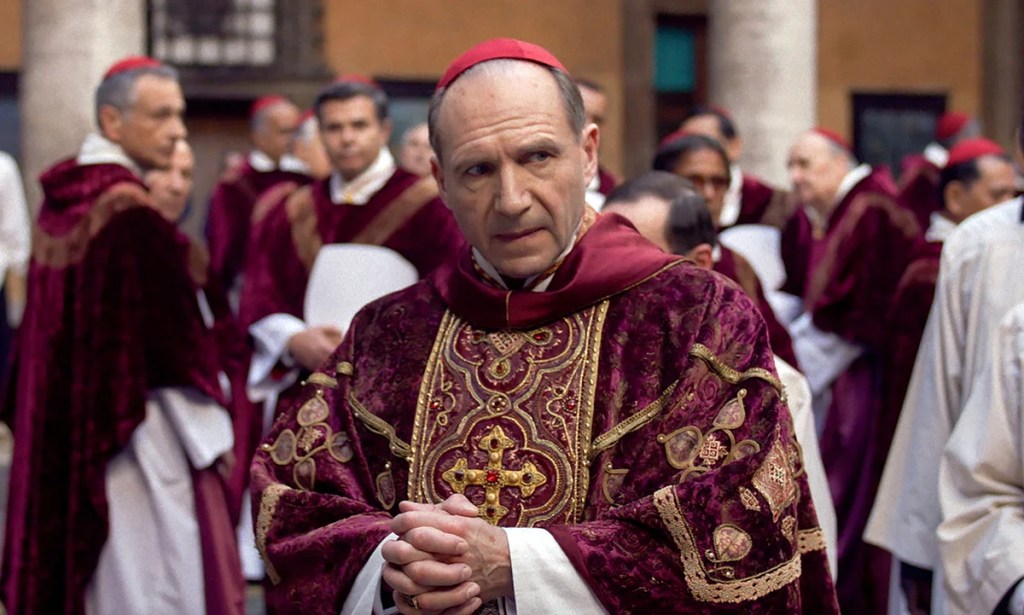
Conclave (Dir. Edward Berger, Screenplay. Peter Straughan): Ralph Fiennes becomes Cardinal ‘George Smiley’ in this bone-dry thriller that could have been titled The Cardinal Who Came In From the Cold. When the current Holy Father dies, reluctant Vatican Dean Thomas Lawrence (Fiennes) is duty-bound to lead the conclave in the papal election. Yet, rumour and suspicion hover through the hallowed halls of the Vatican Palace like incense: who did the Pope meet before he died? Why does a cardinal ordained secretly turn up to conclave just before the election? And will Lawrence help his friends in the liberal wing to defeat the growing reactionary factions of the Church led by the xenophobic Cardinal Tedesco (Sergio Castellitto)? Though the trailer offered a hilarious portentous drama in the melodramatic style of Paolo Sorrentino’s 2016 TV series The Young Pope (though undoubtedly less surreal and sexy), Edward Berger’s adaptation of Robert Harris’ novel is a more sober affair with only a few flamboyant flourishes (especially Volker Bertelmann’s overly dramatic score and Castellitto arriving in a red cape that’s straight out of the arch-villain Cardinal Richelieu’s wardrobe). Reminiscent of a John le Carré novel, the plot twists and turns through its conspiracy of cardinals by flipping document pages and quietly contemplating past memories. Putting aside a couple of hammy moments, Fiennes has gravitas enough to hold our attention through the amateur detective work. The rest of the accomplished cast (Stanley Tucci, John Lithgow, Lucian Msamati) are competent in their suspect roles. Only Isabella Rossellini’s mother-superior gets a spiky mic-drop moment among the pampered elderly priests. This is a passable thriller that offers few revelations and remains light on any real political controversy. My Verdict // ★★★☆☆

![4 EYES ON THE SCREEN: My Top Films of 2025 [Review] – 4 EYES ON THE SCREEN + EVEN MORE EYES: a cinema blog & podcast Avatar](https://4eyesonthescreen.com/wp-content/uploads/2025/06/cropped-cropped-df042c00-9362-4263-8604-aa3fb9311281-1.png?w=40)

