

Director: Rian Johnson / Screenplay: Rian Johnson
In his long-awaited sequel to JJ Abram’s 2015 The Force Awakens, Rian Johnson wastes no time in expressing his attitude toward his instalment of the Star Wars saga. It comes moments after The Force Awakens’ cliff (hanger) meeting between heroes Rey (Daisy Ridley) and Luke Skywalker (Mark Hamill). Skywalker’s reflective stance holding his old lightsaber and subsequent flippant gesture perfectly exemplifies the dramatic emotional weight yet irreverent energy that Johnson brings to The Last Jedi. Through this precariously balanced tone, Johnson can surprise and delight as he seems unafraid to take creative liberties with the established mythos within and surrounding the Star Wars films. However, despite the cast’s natural charisma, which includes the extended screen presence of beloved fan favourites, Johnson struggles to develop a genuinely engaging new direction for the franchise. The obligatory opening crawl declares the Resistance is relying on a ‘spark of hope’ in their plight against the First Order. At the moment, ‘sparks’ of hope feel like an appropriate metaphor for this saga’s future.
Despite the loss of their planet-destroying base in Episode VII, the First Order are in the ascendence while the victorious but weakened Resistance, led by seasoned General Leia (Carrie Fisher) and hot-shot pilot Poe Dameron (Oscar Isaac), attempt a retreat across the galaxy. Overseen by the grotesquely twisted, spiteful Supreme Leader Snoke (Andy Serkis) and helmed by his obsequious henchmen Hux (Domhnall Gleeson) the Resistance grows more desperate as they are unable to escape the First Order’s devastating weaponry. The recently recovered Finn (John Boyega) and determined rebel Rose (Kelly Tran) are sent on a mission to save the burdened movement as their losses increase and alliances fray. Meanwhile, having located the last of the Jedi, Rey finds Luke unwilling to train her in the ancient ways of the Force. “Go away” he snaps wearily, shunning the insistent Rey as he stomps (Crusoe-like) around his island and shuts himself away ruefully in a stone hut. As Poe must persuade the Resistance to fight back, Rey implores the Jedi master to train her so that she can defeat Luke’s fallen apprentice Kylo Ren (Adam Driver). Destinies intertwine and, once again, the fate of the galaxy is at stake…
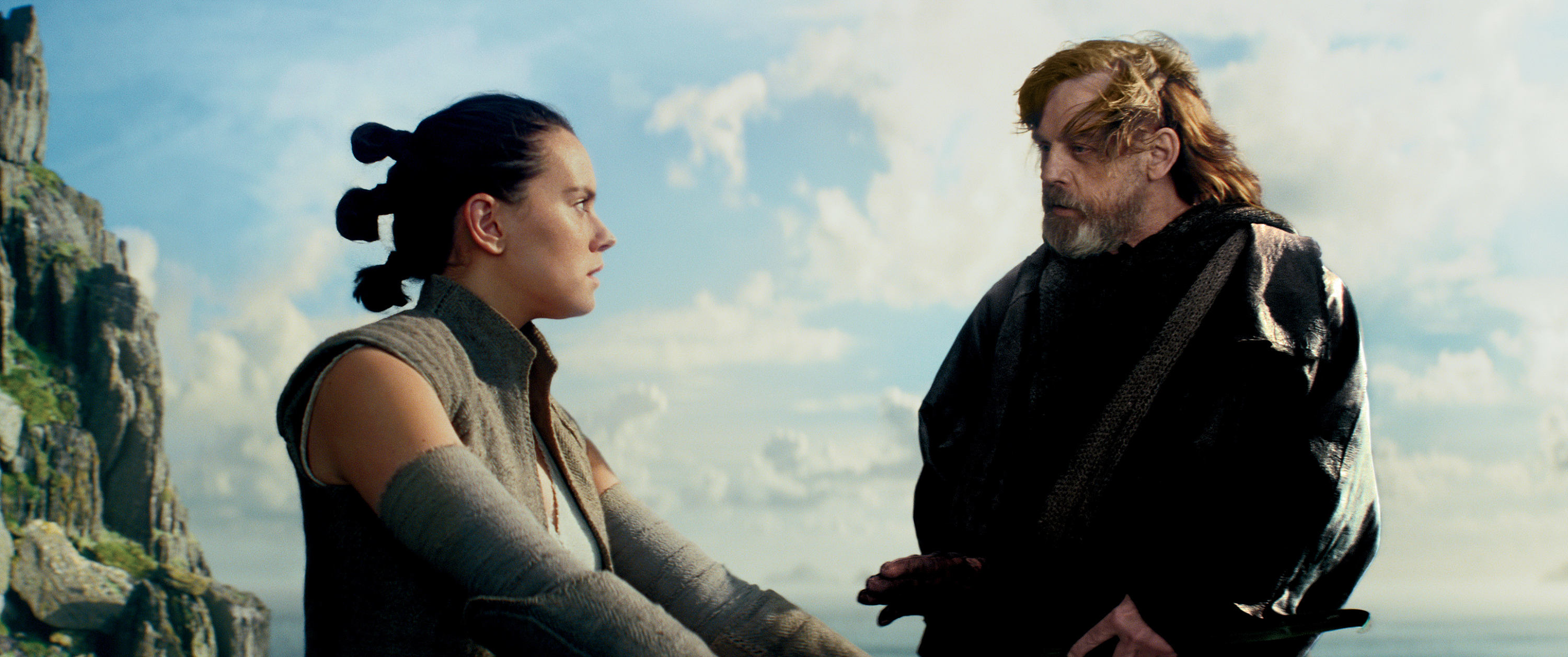
There is a twinkle to Mark Hamill’s performance that just winks lovingly at the audience and his scenes with lead Daisy Ridley concerning the intrigues of the Force are the most affecting in the film.
Johnson’s script and direction, despite issues of pacing, needless digressions (yes, the sojourn to the ‘casino’ planet), and awkward humour (which often feels more appropriate to Mel Brooks or James Gunn’s intergalactic comedies than Star Wars), certainly surprises and delights as it leaves aside the nostalgic derivativeness that so crucially defined The Force Awakens. Undoubtedly seizing upon the feverish speculation surrounding the ‘mysteries’ from Abram’s entry, Johnson appears unafraid to consciously subvert those expectations. This is a double-edged sword, which no doubt has contributed to the (often vitriolic) fan backlash against The Last Jedi since its release. On the one hand, it is refreshing how unexpected some of these revelations are, but on the other, narratively speaking, it sweeps away what The Force Awakens was trying to tease for the upcoming episodes. More intriguingly, Johnson plays with the internal mythology of the Star Wars saga, tentatively questioning previously rooted concepts of the light-dark side dichotomy, hereditary lineages of power and legends that grow out of heroism.
Johnson doesn’t fully commit to deconstructing these established themes nor travels too far from the deeply engrained sentimentality and epically sprawling visuals which are quintessentially Star Wars. There is enough pastiche to appeal to fans, which in my view demonstrates some lack of imagination. There are set pieces, scenes and dialogue that allude to (or even directly quote) The Empire Strikes Back and Return of the Jedi. Likewise, there are sly nods to directors Terry Gilliam and Akira Kurosawa, the latter a well-known source of inspiration for originator George Lucas. Yet in contrast to The Force Awakens, which drew too heavily on A New Hope, some visually striking moments seem unique to the saga: an ultrasonic light speed shattering of an enemy’s ship, a heroic figure walking out alone through flames to face an army against a blood-red sunset; heroes astride an alien-creature being chased across a double-moonlit beach; old friends exchanging truisms on teaching and failure beside a burning ancient tree. All of this is reinforced by composer John Williams’ reliably evocative symphonies, sounding more distinctive here than they ever were in the previous episode.
It’s fair to say that the veterans of the franchise – Fisher and Hamill- bring most of the emotional gravity to the proceedings. Of course, Fisher’s passing brings a slightly distorting poignancy to her performance but, in reality, she’s still given very little to do. Some tough quips (‘Wipe that anxious expression off your face, Threepio’) offer glimpses of the forthright, young princess of yesteryear but otherwise, she’s forlorn and embattled, glued to directing battles from a spaceship console. Appropriate to its title, this is really Hamill’s film. After being relegated to the final thirty seconds of The Force Awakens, the bearded, brooding Skywalker is the most interesting development in this new trilogy, far exceeding the perfunctory performance of Harrison Ford’s aged Solo in 2015. Despite Skywalker’s deep shame, emerging through Hamill’s often tear-filled gaze and general weariness, there is a twinkle to the performance that often winks lovingly at the audience. His scenes with lead Ridley concerning the intrigues of the Force and the past are the most affecting in the film.
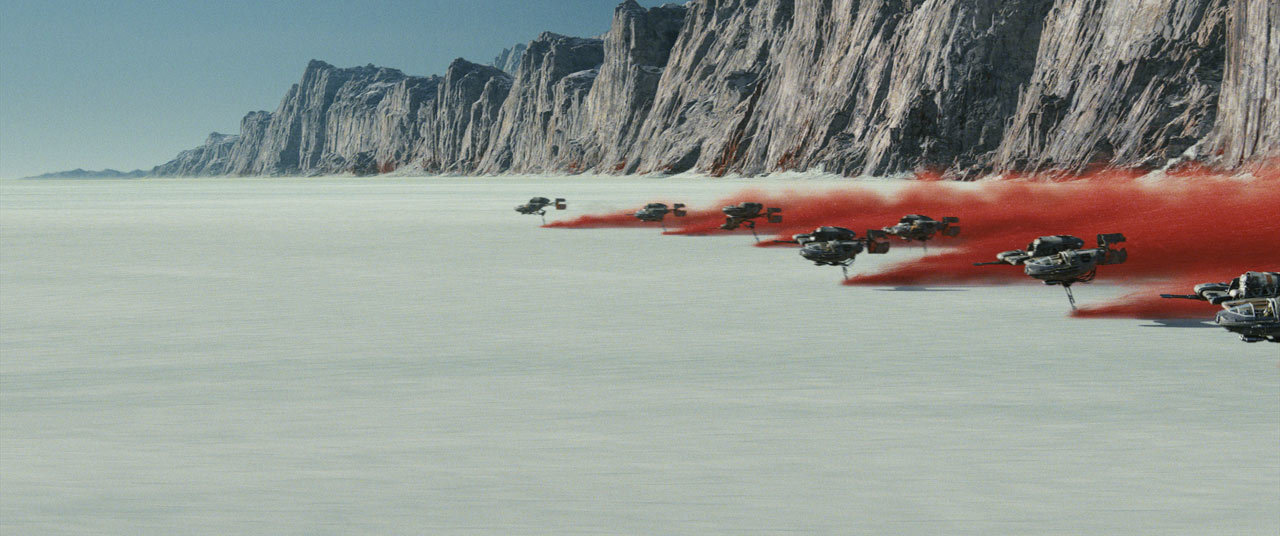
There is enough pastiche here for the fans that demonstrate some lack of imagination: set pieces and scenes that evoke (or even directly quote) The Empire Strikes Back and Return of the Jedi or sly nods to directors Terry Gilliam and Akira Kurosawa. Yet unlike Abrams’ uninspired set pieces, there are some striking, memorable moments in The Last Jedi.
It’s the ‘new kids’ that get somewhat lukewarm (no pun intended) treatment in the script. While Isaac’s Poe finally gets to develop very slightly in this sequel (taking account of his reckless actions as the body count of the Resistance mounts), Ridley, Boyega and Driver are still playing disinteresting characters, despite their likeable screen presence. Ridley is effective enough through her indefatigable determination, with Driver as her angsty foil, but Boyega is often set adrift in the narrative.
The newcomers in Kelly Tran’s Rose and Laura Dern’s Admiral Hondo, while clearly admirable, become merely serviceable to the lengthy plot. Noticeably competing with Driver’s villain is the uncomfortable, pantomimic performance from Domhnall Gleeson’s Hux: a villain of such melodramatic, British RP-clipped lunacy that even his henchmen look at him askance. Benicio del Toro’s stuttering code-breaker feels superfluous and would have been better merged with the redundant Captain Phasma, whose role here confirms the waste of actor Gwendoline Christie.
In my opinion, this is going to be the major problem going forward. Due to the rehashed characterisation established in Abram’s The Force Awakens, which Johnson’s script struggles to develop meaningfully, there is little intrigue for the episode(s) ahead. With our heroes of old beginning to fade away, The Last Jedi takes an uncertain light-speed jump to the next adventure. I have to say, I’m not hugely invested in the continuation of the journey into Episode IX (especially with Abrams back at the helm in 2019).
In many ways, The Last Jedi is the film that The Force Awakens should have been: touching lightly upon the past but actually trying to build for the next generation. The Last Jedi still does homage to the original trilogy with indulgent fan service (though in a meta-moment at its ending, the director tips his hat to the child in all the fans). Johnson has charted a course into an unknown and very uncertain future. While the proverbial torch is starting to be passed on, it remains in danger of flickering out altogether.
My Verdict: ★★★☆☆


 4 EYES ON THE SCREEN + EVEN MORE EYES: a cinema blog & podcast